<body><iframe src="http://www.blogger.com/navbar.g?targetBlogID=10114323&amp;blogName=The+Blue+Planet+Project&amp;publishMode=PUBLISH_MODE_BLOGSPOT&amp;navbarType=BLUE&amp;layoutType=CLASSIC&amp;homepageUrl=http%3A%2F%2Ftheblueplanetproject.blogspot.com%2F&amp;searchRoot=http%3A%2F%2Ftheblueplanetproject.blogspot.com%2Fsearch" marginwidth="0" marginheight="0" scrolling="no" frameborder="0" height="30px" width="100%" id="navbar-iframe" title="Blogger Navigation and Search"></iframe> <div id="space-for-ie"></div>

The Blue Planet Project

This blog has been created to disseminate the information we collect during the activities of the Comenius project: "The Blue Planet: WATER, resource and symbol of the past, the present and the future". This project is funded by the European Community and its duration is 3 years (2003-2006).

).

Wednesday, March 23, 2005


Posted by Hello


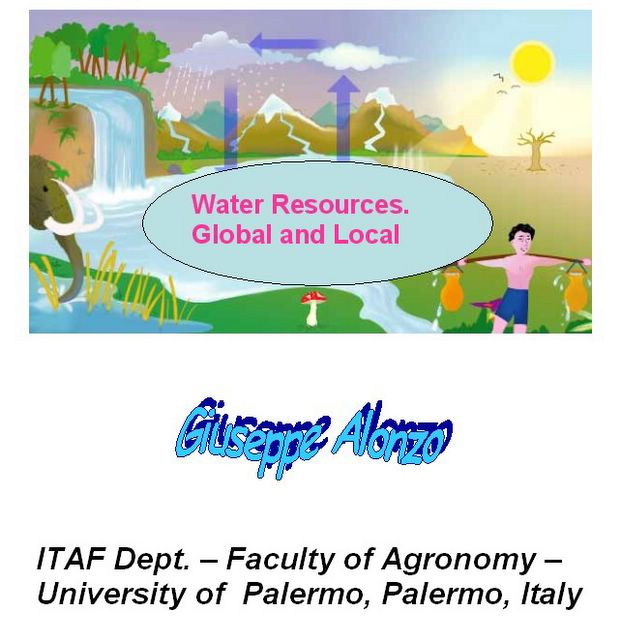
Water resources. Global and local
by
Giuseppe Alonzo

ITAF Dept. – Faculty of Agronomy – University of Palermo, Viale delle Scienze,
90128 Palermo, Italy

Water distribution on Earth

Earth appears from the space as a “blue” planet. The color is due to the water covering about 71% of the whole Earth surface. Water also is present in appreciable amounts under the land surface and as water vapor in the atmosphere. Because of the temperature and pressure ranges available on the Earth, water is encountered in all the three states of the matted and this has been considered of outmost importance for the development of the life on this planet.
The Earth planet is an essentially closed system which means that the matter leaving or entering the system is rather small. Water is also therefore a finite resource which is cleaned and replenished in its different forms through the hydrologic cycle.
The earth has an abundance of water, but unfortunately, only a small percentage, about 0.3%, has characteristics usefull for its use by humans. The other 99.7% is in the oceans, soils, icecaps or present in the atmosphere. Moeover, much of the previously mentioned 0.3% is unattainable. Most of the water used by humans comes from rivers, lakes or the underground provided these met the required quality parameters. The rivers and lakes which are visible bodies of water are referred to as surface water.The majority of fresh water is actually found underground as soil moisture and in aquifers.
Following the U.S. Geological Survey, 1984, the different forms in which the water is found in our planet are the following:
Ocean water: 97.2%
Glaciers and other ice: 2.15%
Ground water: 0.61%
Fresh water lakes: 0.009%
Inland seas: 0.008%
Soil Moisture: 0.005%
Atmosphere: 0.001%
Rivers: 0.0001%

About 300 Km3 per day of water are needed for human uses. Surface water is the easiest to reach and the most common source of water, including potable water. Surface water provides as much as the 80 percent of the water used on a daily basis. Problems, however, exist due to the increasing contamination of the water bodies thus further limiting the amount of water available for human consumption. Water is found in many different forms and in many different places. While the amounts of water that exist seem to be plentiful, the availability of the water for human necessities is limited.
Oceans, which are the largest source of surface water, comprise approximately 97 percent of the earth’s surface water. However, since the oceans have high salinity, the water is not useful as drinking water. Efforts have been made to remove the salt from the water (desalination), but this is a rather costly endeavor. The oceans also play a vital role in the hydrologic cycle, in regulating the global climate, and in providing habitats for thousands of marine species.
Glaciers and icecaps cover 10% of the earth’s surface. Glaciers melting can have a tremendous effect on the sea level. If all of the glaciers were to melt today, the rise of the sea would be about 78 meters.
Ground water is a very plentiful source of fresh water, it must be a protected resource. Once an aquifer is contaminated with chemicals or petroleum, it is difficult, if not impossible, to clean up. Many times, surface water also is in direct contact with underground water and this can create a problem with contamination of the ground water. There is also the problem of saltwater intrusion (present in coastal regions) where over-pumping of the ground water draws the denser saltwater up into the aquifer. So, protection of the ground water should be a high priority as the population on Earth continues to rise and potable water becomes a valuable resource.

The Water Cycle

The hydrologic cycle or more simply the “water cycle” is a pictural representation of how water is recycled through the environment. Water molecules remain constant, though they may change between solid, liquid, and gas forms. Evaporation can occur from water surfaces, land surfaces, and snow fields, into the air as water vapor. Moisture in the air can condensate. Water vapor condenses on tiny particles of dust, smoke, and salt crystals to become part of a cloud. After a while, the water droplets combines with other droplets and fall to Earth in liquid (rain) or solid (for example snow) forms. Once the drop has fallen to Earth, it may go into an aquifer as ground water, or the drop may stay above ground as surface water.
One problem facing the cycle of water on Earth is water contamination. Chemicals that go into the water often are very difficult, if even possible to remove. One potential source of contamination of water is runoff, the overland flow of water. While precipitation causes the runoff to occur, stripping vegetation from land can add to the runoff in a particular area. The sediment and soil from these areas, not to mention any pesticides or fertilizers that are present, are washed into the streams, oceans, and lakes.
What happens to the rain after it falls depends on many factors, such as the intensity and duration of rainfall, the topography of the land, soil conditions, amount of urbanization, and density of vegetation.
Water on Earth is a finite source. Protecting the water means protecting all forms of the water found on Earth. Water at the surface, under the ground, in vapor form, and as precipitation. Pollution from using fossil fuels can impact all forms of water (from crude oil leaks to acid rain generated from coal burning). Acid rain falls onto the land and flows into the surface water, back into the ground, and back into the air. It can be an endless cycle. As contamination infiltrates the water cycle, more water will be impacted. Most of the water on Earth is saline. Fresh water is and will be in demand and become a very valuable resource. Care must be taken to prevent overuse of potable water sources. Care must also be taken to protect the earth’s waters from contamination. Water is indeed a valuable resource.

Water resources in Sicily

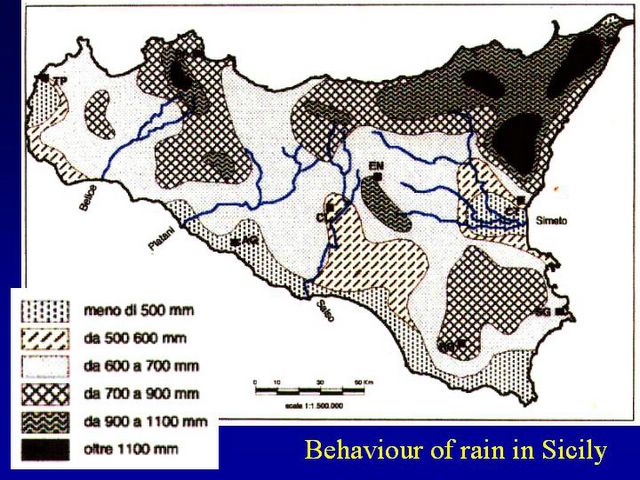
A variety of hydro-orographical factors influence the climatic characteristics of Sicily. Recent data confirm that Sicily is going to a semi-arid behaviour characterized by an increasing drought frequency.
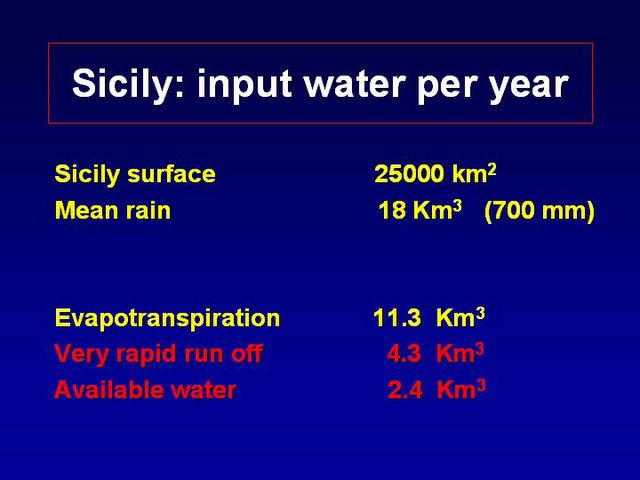
The surface of Sicily is 25.708 Km2. The flat land is 14.2%, hills contribute for 61.4% and mountains result to be 24.4%. The overall population is a bit more than 5.000.000 people.
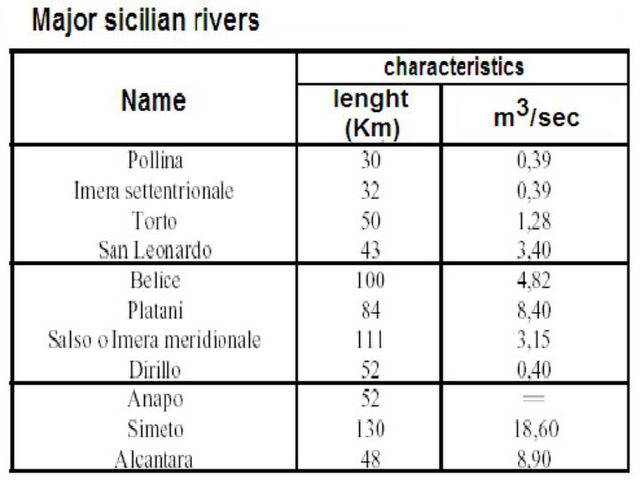
There are no major rivers in Sicily, there are however several minor, of which the Simeto and the Alcantara on the Ionian side of the island are the most interesting. The Salso (South Imeria), Belice and Platani are long rivers but have very low water volumes. The absence of major rivers is one of Sicily's greatest problems; lack of water. The few rivers and lakes that exits are by no means sufficient to sustain the needs of the population mass.
If we consider that at least 50 liters of water, including civic, industrial and agricultural activities, are required per person and per day, following FAO recommendations, it can be easy obtained that 0.25 Km3 of usable water would be required by the whole sicilian people. During one year, the amount of required water would be about 90 Km3.
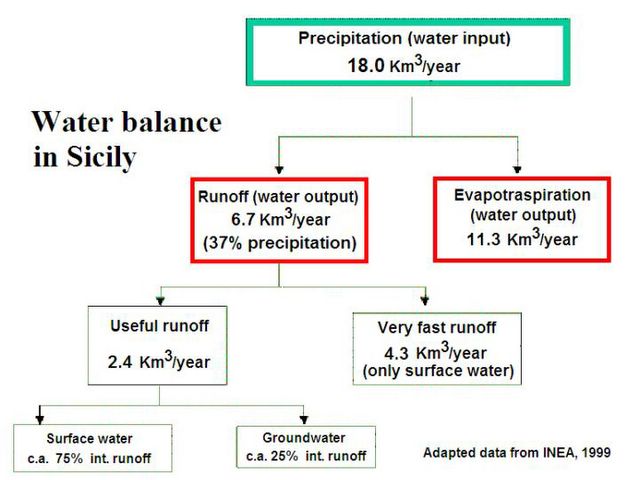
Meteoric water in sicily contributs for 17.5 Km3 (700 mm medium value for the whole sicilian surface) and, therefore, from rain we get about 20% of what is really needed.
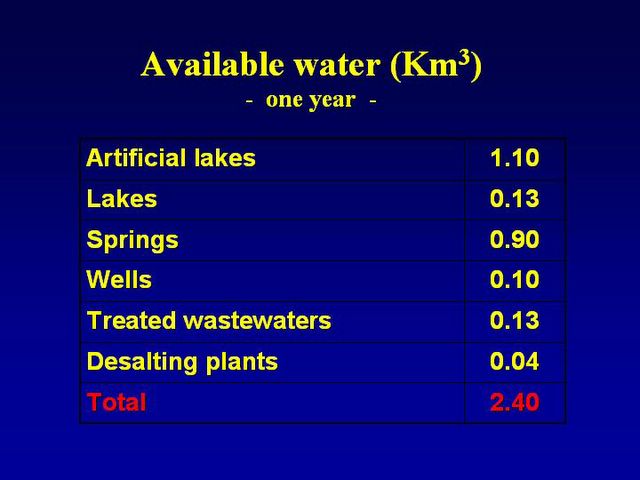
Plants transpire water and thus requires replenishment at rates which are dependent on the plant microclimate (leaf temperature, solar radiation, air humidity, wind speed), the plant age, morphology, health, and the ease at which the water is available within the root zone. In Sicily, as much as 63% of the whole water received from sky is lost through evaporation and evapotranspiration fenomena. Therefore, each year only 6.2 Km3, corresponding to the remaining 37% will be available for uman uses. Considering run-off fenomena and that water fraction becoming underground water, only 2.3 Km3/Year.will be available for human uses and they result sub-divided as: 0.7 for civic uses, 0.4 for industrial uses and 1.2 for the agriculture.
Sicily suffers therefore of an acute water scarcity. On the other hand, one of the characteristic aspects of urban development is the widespread availability of piped water, a sewage system and the resultant production of urban wastewater. Because water is in the short run even more critical than food for human survival, it seems necessary to plan the reuse of urban wastewaters especially during meteorological drought. This rather stable production of urban wastwater should be perceived by planners as a real asset not to be wasted!

This lecture was delivered by the writer during the project meeting in Carini-Sicily-Italy (October 2003)
Presentation of Dr. Alonzo's lecture


The new bridge connecting Peloponnese and the mainland of Greece at Rio. Its length over the sea is 2252 m. It is one of the biggest cable bridges in the world. More information in the site: www.gefyra.gr. Photo by Mr. Panagiotis Giakis, Principal of the 8th Unified Lyceum of Ioannina Posted by Hello

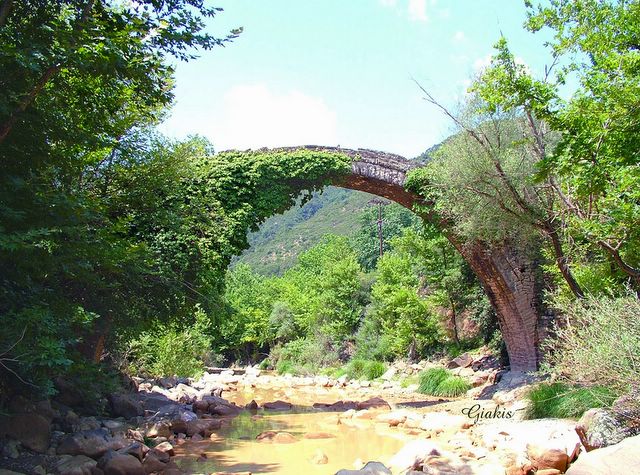
The famous bridge in Arta of the Arachthos River. A well-known in Greece bridge by one of the best in the Balkans folk ballads, saying that it was needed the chief engineer's wife to be built alive into the foundation, otherwise the bridge could not be finished. A ballad that has many variations from India to the Eastern Europe. More information in the pages: Hellenic culture ( The Arta Bridge) and Yiayia's corner .Photo by Mr. Panagiotis Giakis, Principal of the 8th Unified Lyceum of Ioannina. Posted by Hello

Photo by Mr. Panagiotis Giakis, Principal of the 8th Unified Lyceum of Ioannina Posted by Hello

Old Bridge in Epirus-Greece-Photo by Mr. Panagiotis Giakis, Principal of the 8th Unified Lyceum of Ioannina Posted by Hello

Old Bridge in Plaka, Arachthos River-Photo by Mr. Panagiotis Giakis, Principal of the 8th Unified Lyceum of Ioannina Posted by Hello

Photo by Mr. Panagiotis Giakis, Principal of the 8th Unified Lyceum of Ioannina Posted by Hello

Saturday, March 12, 2005

Presentation of the Profs. Roberto Triolo and Irene Ruffo's lecture


Posted by Hello


Water in Nature and Possible Industrial Uses

By
Roberto Triolo and Irene Ruffo
Dipartimento Di Chimica Fisica – Università di Palermo – Palermo (Italy)

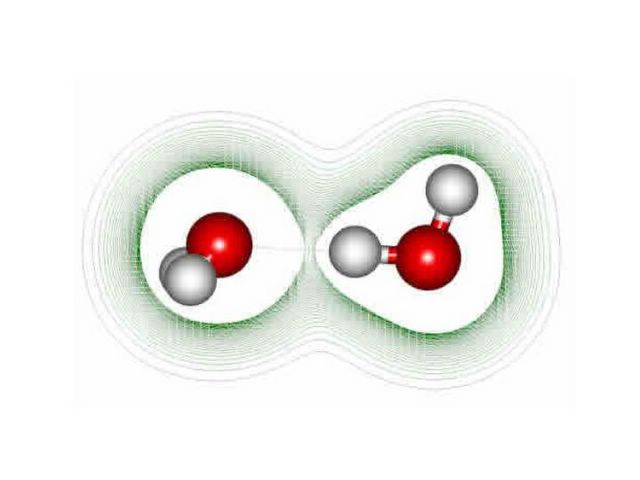
Liquid water (H2O) is the most common substance in the world. Despite being apparently so simple, and therefore despite being considered an ordinary material, water is able to display a variety of different properties which make it the most important material in Nature. If we think how our day starts and how ends, how our days progress, we shall probably realize that most of our activities depend on water. The water molecule is very simple and small. Only three atoms make it: two Hydrogen atoms (H) and one Oxygen atom (O). However H and O are quite different atoms, the first one being very electropositive (has tendency to acquire a positive charge) and the other has tendency to acquire a negative charge. However, the


Posted by Hello


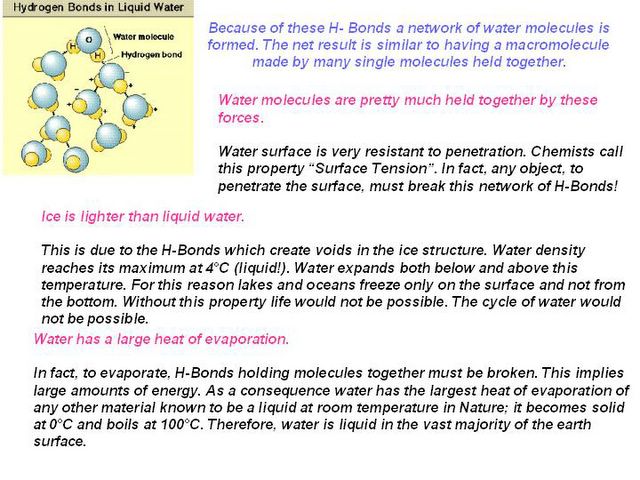
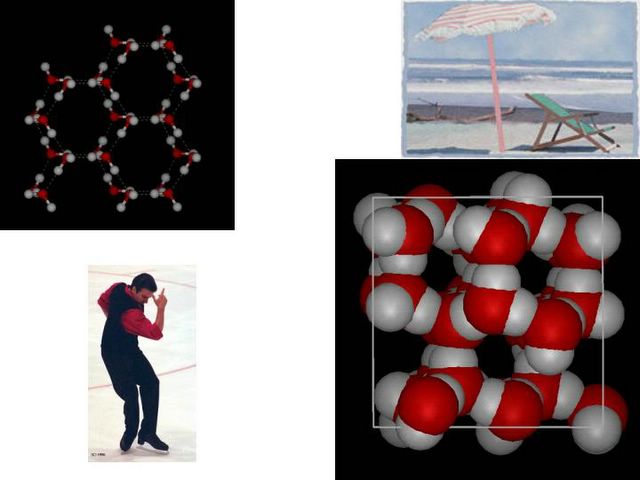
extraordinary complexity of its properties is also due to its size; on the other hand these properties seem to fit ideally into the requirements for life as no other molecule. All the most interesting properties seems to derive from the possibility of the opposite charges to interact generating a peculiar type of “bond”: the Hydrogen Bond (H-bond) which is responsible for the high specific heat, the unusually high heat of fusion and heat of evaporation, the high melting and boiling point, and the possibility of acting as solvent for polar molecules in its Normal Water conditions (NW) and as a more “organic type” solvent in Near Critical (NCW) and Super Critical (SCW) conditions. H-bonds are formed as the Hydrogen atom (the positive end of the molecule) is attracted from the Oxygen atom (the negative end of the closest water molecule). In these conditions a network of water molecules is formed. The net result is similar to having a macromolecule made by many single molecules held together. Water molecules are pretty much held together by these forces, so water surface is very resistant to penetration. Chemists call this property “Surface Tension”. In fact, any object, to penetrate the surface, must break this network of H-Bonds. A difficult task! It is well known that ice is lighter than liquid water: also this property is a consequence of the H-bonding, which create voids in the ice structure, and therefore a given volume of ice will weight less than the same volume of liquid water, which is heaviest at 4°C. Below and above this temperature water is lighter. The consequence is that lakes and oceans freeze only on the surface and not from the bottom. Without this property life would not be possible, neither the cycle of water would be possible. Water has a large heat of evaporation because, to evaporate, H-Bonds holding molecules together must be broken. This can be done, but only if large amounts of energy are used and so water has the largest heat of evaporation of any other material liquid at room temperature in Nature; water becomes solid at 0°C and boils at 100°C and therefore is liquid in the vast majority of the earth surface. When compared with the gas phase (water vapour vs. air), one may notice that water warms up more slowly and cools down more slowly than air. This makes life more comfortable for the living creatures, as our body temperature is basically constant, despite the seasonal and daily changes of the atmosphere. In the table shown in the next page some of the properties of water are reported together with their relevance to environmental issues. Finally the strong H-bonding which characterizes the solid form of water makes ice a very peculiar material. It is possible to slide on it, to skate on it, to make it act as heat sink, helping to maintain an average temperature ideal for life processes. Let’s now assume that we are breaking these bonds. When the H-bonds progressively break, water loses more and more the characteristics of solvent able to solubilize salts, acids and many of the basic chemicals necessary for life (“polar solvent”), and starts to become more like typical organic solvents (“apolar” solvents). So, while at room temperature and pressure water is a poor solvent for plastics, in Supercritical conditions (high temperature and high pressure) becomes a good solvent for plastics. In turn this means that water (which is not dangerous for the environment) may replace solvents like benzene and Fluoro-Chloro-Hydrocarbons which are used in many industrial processes and are very dangerous for the environment. In a sense we may consider water as a sort of universal solvent, whose properties can be changed at will by changing its physical conditions (T and P), so one may expect dramatic changes in the solvating properties of water, moving across the phase diagram. In view of these properties, it is possible to find applications for supercritical water (SCW) in eco-friendly processes. For example many organic molecules, as well as O2, N2, CO2, are miscible in all proportions with water under these conditions. This makes SCW a good medium for combustion reactions , while it may dissolve organic materials, like waste materials, garbage etc. This opens a variety of possible processes.

Reactions and Phase Equilibria in Near-critical Water (NCW)

In the temperature range of 250 to 350 °C (near-critical) water is an environmentally-benign solvent for a wide variety of manufacturing processes in the chemical, petrochemical, pharmaceutical, and plastics industries.

Posted by Hello


In general NCW has the following advantages:
· Replaces many less desirable solvents, such as aromatic hydrocarbons and chlorinated compounds, reducing the environmental impact.
· Avoids the use of polluting mineral acids and hazardous catalysts.
· Permits the minimization or even the elimination of unwanted by-products.
· Provides better control of reactions which can be run homogeneously instead of heterogeneously.
· Facilitates closed processes by reuse of waste material.
· Provides simple separation after reaction.


Reactions and Phase Equilibria in Super-critical Water (SCW)

The chemical and physical properties of SCW, makes it an ideal medium for oxidation reaction of organic materials and their mixtures wit/without eteroatoms (halogens, sulphur, phosphorus, etc). The final products would be water and carbon dioxide for the organic portion, acids, bases and salts for the remaining portion. All these products can be easily separated and therefore pollution is very low. For this reason over the past decade, a major research effort has been focused on the destruction of toxic organics by means of total oxidation in SCW. The process is highly effective but there can be serious problems of corrosion associated with large scale waste destruction, so serious indeed that many chemists have been discouraged from even contemplating possible uses of SCW as a medium for chemical reactions.


Posted by Hello


Recently, however, there have been a number of reports which show that high temperature and supercritical water can be used constructively for reaction chemistry. The figure summarizes the main advantages of using SCW as reacting medium. Also a list of possible applications which begin to be explored is presented.
We wish to end this presentation reminding that Nature has already applied most of the “techniques” and “approaches” presented in this paper. Most geological fluids, in fact, contain water and carbon dioxide in supercritical conditions. This permits all the chemical transformations which give life to a variety of geochemical materials. It is for this reason that scientist have begun very recently to investigate not only NCW and SCW, but also mixtures of supercritical fluids, with water and CO2 as primary components.
This Lecture was delivered by the writers during the project meeting in Carini-Sicily-Italy- October 2003

Sunday, March 06, 2005


The Hydroelectric dam of Louros River, Ioannina- Greece- Photo by Mr. Panayiotis Giakis, Principal of the 8th Unified Lyceum of Ioannina Posted by Hello

Gormos River-Photo by Mr. Panayiotis Giakis, Principal of the 8th Unified Lyceum of Ioannina Posted by Hello

Gormos River (Ioannina, Greece)-Photo by Mr. Panayiotis Giakis, Principal of the 8th Unified Lyceum of Ioannina Posted by Hello

"Theogefyro" (The God's Bridge) over Gormos River- Photo by Mr. Panayiotis Giakis, Principal of the 8th Unified Lyceum of Ioannina Posted by Hello

Photo by Mr. Panayiotis Giakis, Principal of the 8th Unified Lyceum of Ioannina Posted by Hello

River in Ioannina territory -Greece- Photo by Mr. Panayiotis Giakis, principal of the 8th Unified Lyceum of Ioannina Posted by Hello

Voidomatis River (Ioannina-Greece)-Photo by Mr. Panayiotis Giakis, Principal of the 8th Unified Lyceum of Ioannina Posted by Hello

Voidomatis River in Vikos Gorge (Ioannina-Greece)-Photo by Mr. Panayiotis Giakis, Principal of the 8th Unified Lyceum of Ioannina Posted by Hello

Saturday, March 05, 2005

Presentation of Prof. Irene Ruffo's lecture


Posted by Hello
Man and Water

By

Irene Ruffo

I wish to start this presentation by showing a picture from space taken by a satellite and showing a peculiar characteristic of our planet: the presence of great amounts of


Posted by Hello

water. The Hearth is shown on the right side. The clouds (water vapour mixed to small water droplets) make less evident the contour of the continents, surrounded by the blue oceans. Is not by chance that the Earth is known also as “The Blue Planet”. The Earth is the only planet in the known Universe in which one may find two interconnected and rather unique features coexisting: the presence of liquid water and the existence of forms of life in continuous evolution. The other planet (shown on the left of the picture) is Mars, known also as “Red Planet”; it is the planet that is more similar to Earth, although important differences exist, so much so that there is no general agreement on the possibility of life on it. Let’s jump back in time a few billion years ago, about one billion year after that great event which shaped our planet. During this time the temperature of the Earth dropped quite a bit and the condensation of the water vapour generated the huge amount of liquid water which, according to the vast majority of the life scientists, did allow the birth of simple forms of life; these, in turn, generated more advanced forms of “terrestrial life”. This was just the beginning of a complex process involving a variety of interests from physics to chemistry, to biology, to history, to philosophy. It is not surprising that so many different sciences have been involved, given the importance of the event, an event of enormous importance: “The Event”. Before addressing social and political issues, let me first quickly summarize pieces of chemical, physical and biological information which will help to explain why the first forms of life starter in liquid water (oceans) and why the first “complex living entities” did emerge from the water heading toward the hearth and giving birth to the most important and evoluted terrestrial form of life: the Man.
The starting point of this presentation is the acknowledgement of the fundamental role which has been plaid by the Sun in starting the vital processes on Earth. It is well known that the history of the geochemical and biological evolution of Hearth shows that life could start and develop only when conditions became less hostile and, more important, only after formation of a primitive hydrosphere containing liquid water and the starting of the biogenetic cycle of water.
It is also known that Sun radiates energy as electromagnetic waves in a range of frequencies. Among the others, UV radiation is particularly dangerous for the living objects. Fortunately this kind of radiation is efficiently screened by the atmosphere surrounding the Hearth, especially by Oxygen (O2) and even more so by the Ozone (O3). Depletion of the ozone layer due to pollution, results in increased UV radiation reaching the Earth’s surface. This has raised great concern for the related health effects of skin cancer, cataracts, and immune suppression.
At the beginning the Earth’s atmosphere had no Oxygen, which came later when plants produced it through the photosynthesis associated with the action of clorophyll, a complex, but extremely useful molecule. Therefore, Earth was absolutely hostile environment.

Posted by Hello
Molecular Structure of Clorophyll


Water, absorbs the UV radiation making underwater life possible. This, together with experimental evidence collected over the years have suggested that life starter in the oceans at a depth such that while part of the radiation was absorbed, part was still be used for photosynthetic support to primitive living organisms. This complex of factors triggered the beginning of life. During a lengthy process of evolution, which took several hundred million years, these primitive forms of life evolved in forms more complex which, eventually were able to leave to “natural aqueous medium” and migrated towards to Earth surface. In fact, in the mean time conditions able to support more complex forms of life had started on Earth (cooler temperatures, oxygenated atmosphere, filtered UV radiation, just to mention the most important factors). It is in this scenario that man made his appearance. On one side generated from water on the other side owner of this incredible wealth. Water, in fact, is the most spread material on Earth, and, at the same time, the most important. The human body is made of water to a great extent (almost 70% by weight). Some animal and/or botanical species reach even higher percentage (almost 99 %). Our body may survive several weeks without food, but would survive only a few days without water. For these reasons water is considered source of life, way of purification, regeneration center. Starting from water men have built civilization. For possess of water, wars have been started. With the help of water progress in science, technology and industry has been accomplished. Nearby rivers and lakes, the greatest civilizations were born. Survival of living being, animals, plants is due to water. Water is there where life is, without it life is not possible. Abundance of water has been the key factor to develop civilization and prosperity. Sumeri established themselves in an area not greater than our Lombardy, where two rivers (Tigris and Euphrates) over 5000 years ago merged separately into the Persian Gulf (today they merge and become a single river before reaching the gulf). People living in the area managed to make the ground suitable for cultures also by controlling the regular flow of water. Another great civilization grew and become strong along the river Nile. Not to mention the great cultures of the Mediterranean area, all of them connected, one way or another, to water. At one stage, Arabs took over Sicily and started a domination which had strong influence on the local population. Arabs learned methods and techniques in the field of hydraulics, modified them and introduced them in worlds away from them. For example they learned from the Latin world the technology to build water aqueducts and to irrigate fields for agricultural purposes. Their experience in desert areas was of paramount importance in building and protecting water supplies. From the people of the Persian area they learned how to build and protect water ducts. Starting in the VII century A.C. through a tough politics of expansion, trading, culture exchange, Arabs made available to populations of the territories occupied the technology mentioned above and promoted a formidable technological improvement which lasted more than a millennium. This changed dramatically the situation of many regions of the Mediterranean Area, and especially Sicily. Among the hydraulic structures due to the Arab domination, the water-mills of the Gaggera Valley (Sicily) have been preserved in good conditions. Finally the role which the Ancient Italian Maritime Republics had in shaping what it is now Italy, clearly indicate how important was water for the human being. In full respect of Nature, without seriously affecting the environment, in antiquity man used this great source of wealth and civilization. However, slowly things started to change, especially in the XIX century with the beginning of Industrial Era. At the same time the most powerful Nations started unilateral social and economical political choices, quite often strongly bound to water. It is no secret that the majority of wars has been generated by interests involving control of land through control of commercial routes, mostly terrestrial and naval. All the Nations tried to find legal and political ways (International Treaties, Supra-National Organisations, like, for example United Nations) in order to find rules and ways to have legal access to world resources, including water. Unfortunately, as a consequence of the rampant race towards consumism, of the use of water as a sort of universal solvent for a variety of industrial processes, of the generation of huge amounts of highly polluting chemicals, of a blind and irresponsible producing policy, of the wrong believe that Nature could fix all the problems created by man, the situation is drifting out of control. Experts believe that we are going to face a long time of serious shortages of water, whose quality, in any case, will not meet the criteria for a well balance development of the society. Particularly serious will be the problem related to the supplying of drinkable waterin terms of quality, quantity and costs. There seems to be general consensus on the fact that in the next 10-15 years the cost will jump a factor 5 to t10 higher than to day costs. Reasons for this trend are more strict laws and regulations on one side and scientific evidence that trace elements present in “normal” water used in drinkable supplies may be responsible for serious sickness and leading causes for the spread of cancer in our society. To prevent confrontation and danger of wars as well as to reduce the ecological disaster that this scenario seems to indicate, many International Organisations are soliciting actions from the most responsible Nations in the world. For example, Green Cross International, a non government association founded by Mikhail Gorbaciov involved in promoting eco-sustainable development, indicates river basins and especially dams, as the most serious potential source of conflicts. “All dams have an impact beyond any frontiers, not only geographical, but also economical, political and cultural. Problems involve not only the owners and builders of the dams, but the entire eco-system. Chemistry, physics and geology of the neighbour areas are affected. Even earthquakes, in some cases, are thought to be related to the construction of some dams. According to Green Cross International, “ in almost all the fluvial basins of the world (about 300) the effect of the dams is to produce conflicts: between States, between regions, among the different sectors of society, between central and local governments. Conflicts which destabilize regions and represent an additional trouble for Nations already among the poorest in the world”. Green Cross International, in cooperation with UNESCO, recently started a programme “Water for Peace” with the aiming of studying six of the greatest fluvial basins in the world. Two each in Europe and in Africa, one in south America and one in Middle East. The purpose is to find new approaches, including techno-political alternatives, offering the opportunity to introduce new applications of well-tried technology to solve long-standing water problems which are at the centre of many of the potential sources of conflicts. “Local people, authorities, government representatives, the research community, farmers, industries, women and minority groups all need to be fully involved in the development of basin and aquifer strategies, agreements and institutions. Stakeholder representatives and local authorities must be given a permanent and official role in decision-making and implementation. Awareness raising and education strategies should be implemented to ensure that people learn how to best take up the challenges of sharing water”
Peace is at stake especially in the Jordan River Basin, already shaken by turmoil and war. 50 years ago the amount of water discharged by the river into the Dead Sea was about six time larger than to day. Therefore, it is not unreasonable to expect wars “for water” even if ideologically justified! Naturally a lot might be accomplished if water will mainly be used for drinking and agriculture, limiting its use for polluting industrial processes as much as possible. In this respect could be important to promote use of supercritical fluids, environmentally friendly and reasonably inexpensive. A number of interesting actions have been taken in this direction by ONU like, for example celebrating the year 2003 as “International Year of Freshwater”. Certainly a planetary and global educational effort in the direction of properly using and sharing natural resources will produce results of great relevance.
For this reason I wish to conclude this presentation with the poster of the official site of the International Year of Freshwater.


Posted by Hello

(This the complete text of the lecture delivered by Mrs. Irene Rufo, biologist, during the project meeting in Carini-Sicily- Italy, October 2003)