<body><iframe src="http://www.blogger.com/navbar.g?targetBlogID=10114323&amp;blogName=The+Blue+Planet+Project&amp;publishMode=PUBLISH_MODE_BLOGSPOT&amp;navbarType=BLUE&amp;layoutType=CLASSIC&amp;homepageUrl=http%3A%2F%2Ftheblueplanetproject.blogspot.com%2F&amp;searchRoot=http%3A%2F%2Ftheblueplanetproject.blogspot.com%2Fsearch" marginwidth="0" marginheight="0" scrolling="no" frameborder="0" height="30px" width="100%" id="navbar-iframe" title="Blogger Navigation and Search"></iframe> <div id="space-for-ie"></div>

The Blue Planet Project

This blog has been created to disseminate the information we collect during the activities of the Comenius project: "The Blue Planet: WATER, resource and symbol of the past, the present and the future". This project is funded by the European Community and its duration is 3 years (2003-2006).

).

Thursday, April 28, 2005

A long journey among the flames of hell.


The Divina Commedia is one of the greatest poems of the Middle Ages. The work is divided into three parts (cantiche): Inferno, Purgatory and Paradise, each containing 33 Cantos, plus the introductory Canto I of Inferno. The part we have studied this year is the Inferno.



Dante conceives Hell as a great funnel-shaped cave lying below the northern hemisphere with its bottom point at the earth’s centre where Lucifer lives. Around this great circular depression runs a series of ledges, each of which Dante calls a Circle. Each circle is assigned to the punishment of one category of sin, which becomes worser as the abyss gets deeper. The circles are populated with monstruous mythological creatures which guard the place they are assigned to. Dante depicted this imaginary place according to the mentality of his time: a dark world with no stars, where there is only weeping, pain and cries: a gloomy, deep atmosphere at times violently swept by strong winds whose blows are as feroucious as the roar of a stormy sea or as the heavy cold rains which constantly shake the damned souls. Thus Dante describes the Gate of Hell, a blank place where everything is wrapped in heavy shadows.

Dante imagines to be the protagonist of an extraordinary journey that lasted about one week and which took him, during the Spring of 1300, through the three realms of the afterlife: Hell, Purgatory and Paradise. The journey is full of tremendous obstacles and the gloomy atmosphere of hell frightens the traveller. Yet, he is not alone, but is guided by Virgil, the Latin poet who lived in the 1st century B.C.
This journey should not be looked upon as a mere narrative description of the afterlife, but must be interpreted following its deep, allegorical meaning: Dante represents mankind who experiences a profound spiritual crises which one can overcome only if aided by human reason (represented by Virgil’s figure) and faith.


The guardians of Hell

Dante’s poem thrills the modern reader’s imagination by the use of various mythological figures, monsters which are to be found at the entrance of each circle. Among these:
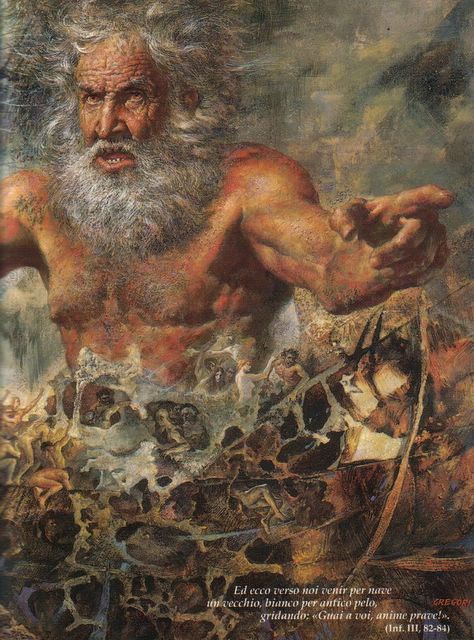
Charon, the ferryman who carries the dead souls across the Acheron, the first of the rivers of Hell, over to punishment. He is not a wise man; he is old and has a thick beard as white as his hair; with eyes of flames he threatens and frightens the damned souls.
Minos is the dread monster, judge of the damned who horrendously growls like a dog while assigning to each soul its eternal torment. After hearing each admission of sin, he decides to which circle sinners must go. Then his tail twists around him forming as many circles as those the damned soul must descend.
Cerberus is the ravenous three-headed dog of Hell who barks against the sinners that lie in the slush. He has eyes of fire, a large belly and with his claws and teeth rips and tears the souls of the third circle: the Gluttons.a hoarders’ sins.
Each of these monsters tries to stop Dante from descending through the circles of Hell, but Virgil silences them and so the poets move on.
Ed elli a me: " Le cose ti fier conte,
quando noi fermerem li nostri passi
su la trista riviera d’Acheronte".
Allor con li occhi vergognosi e bassi,
temendo no ‘l mio dir li fosse grave,
infino al fiume del parlar mi trassi.
Ed ecco verso noi venir per nave
Un vecchio, bianco per antico pelo,
gridando: "Guai a voi, anime prave!
Non isperate mai veder lo cielo:
i’vegno per menarvi a l’altra riva
ne le tenebre etterne, in caldo e’n gelo.
E tu che se’ costì, anima viva,
pàrtiti da cotesti che son morti".
Ma poi che vide ch’io non mi partiva,
disse: "Per altra via, per altriporti
verrai a piaggia, non qui, per passare:
più lieve legno convien che ti porti".
E ‘l duca lui: "Caron, non ti crucciare:
vuolsi così colà dove si puote
ciò che si vuole, e più non dimandare".


(Inferno, Canto II, Dante Alighieri, La Divina Commedia)

This text is a work of the Italian school of Liceo "Ugo Mursia"- Carini

Tuesday, April 26, 2005

Myths on Water

General
The Myth

The Myth is an imaginary narration of fabulous and magic genre, telling the exceptional deeds of heroes and supernatural beings. It gives a fanciful and an irrational explanation to the many events and the natural phenomena that man was not able to explain, as for example the origin of mankind, the existence of life and of the universe, the prevalence of death over life, the eternal contrast between good and evil.
In this sense the myth is also the idealization of an event or of a character, so important to attract and fascinate in a deep and irrational way the popular collective imaginary.
The world “myth” derives from the Greek language and means exactly story, legend.
The myths originally were handed down from generation to generation orally by word of mouth, thanks to men responsible for this function: wizards, priest, cantors, bards.
Only in a second moment some poets wrote down the Myths, even if this didn’t prevent their popular oral transmission.
Since the most ancient times all the people have felt the necessity of relating their own vision of life and of the world: the Myths express the fundamental conceptions of each society, the experience of the people, they represent the soul of a community, in this sense, they are a precious and irreplaceable cultural heritage of any people or social group, as they reveal their way of living, their uses, the costumes, the religious beliefs. Every people on the Earth, as primitive and culturally simple can be, have produced their myths, relating to the differences of time and place, social and economical organization.
At the same time, even if they belong to people completely different among one another, the myths present some identical characteristics as the essence of the human nature is almost equal; therefore also the myths belonging to people living in primitive state as the Boscimans or the Bantus, have something in common with those read in the pages of people that have attained, in their historic path an elevated degree of civilization as the Egyptians, the Greeks and the Romans.
The Myths are an example of the culture and civilization reached by each people: varying from the simplest and unsophisticated narration to the most elaborated expressions, being, always the symbol of the prestige of advanced and complex forms of civilization.The grandeur of the myths is entrusted to the written codification given by the greatest authors of the past. For the Latin world the encyclopaedic references were the Latin writers Ovid and Virgil, that represent the most authoritative and reliable source, from which all the other writers drew inspiration. Ovid’s “Metamorphosi” have been an important reference point for all the Middle Ages. Their tales and stories have the precise objective to give an explanation to reality, to what man can’t explain, to what somehow, concerns man and his necessities.
Myths, legends and tradition in Sicily
Sicily is perhaps the most suggestive and exciting land in the Mediterranean area where legends and traditions meet, making it a cradle of great civilization.
Since ancient times it has been the scenery of Myths and legends that have intermingled with its religious roots, many of them have much to do with water as the symbol of life, of agriculture, of what was really important and essential to the insular life.
Sicily is unique as unique is his people that have been able to preserve a specific cultural identity throughout the centuries and the different dominations: The Phoenicians, the Greek, the Byzantine, the Arabs, the Normans, the Swabians, the Aragonese, the Spanish, the Angevins, the Austrians, the Bourbons.
This land of culture and kindness is open to all his visitors with the incantation of his eternal beauty, with the majesty of his history, the splendour of his art and the magnificence of his monuments, and above all, with the hospitality of this people.
Strong is its tradition of ancient myths linked to water, some of them will be presented as an example of our greatest cultural heritage.

(This is a work of the Italian School Liceo "Ugo Mursia" in Carini)

Monday, April 25, 2005

Myths on Water

The legend of Scilla and Carybdis


The legend narrates that Aci, the son of Fauno and the nymph Simete, fell passionately in love with the nymph Galatea, who reciprocated his love. Unluckly she was also the object of desire of the Cyclops Polifemo, who didn’t accept to be refused. Beyond description was his wrath when he saw Galatea in the forest embraced with Aci tenderly, furious and blinded with rage he didn’t hesitate to hit the rival with a huge rock, wounding him to death.
The poor Galatea started weeping so much that the Gods, moved by her grief, turned Aci’s blood into water, originating the river Aci, near Catania.
Another version tells that Galatea’s tears turned into a river and Aci became its God and finally another version tells that Galatea eventually accepted Polifemo’s love.
Indeed in Sicily really exists a river called Iaci that originates from the slopes of the Etna.
Historical references:


  • Ovid Metamorphosis XII
  • Petrarca Trionfo d’amore II,169-171

(This is a work of the Italian School Liceo "Ugo Mursia" in Carini)

Sunday, April 24, 2005

Myths on Water

The Acheron and its mythological meaning

There is a language understood by everybody which neither evolves nor dies , as it is atemporal: a language that tells us our past, delivering to the eternity, to the collective imaginary, places and heroes, the divinity and the humanity through which man doesn’t feel immortality denied and comes out of the darkness of ignorance; through the experience of heroes whom he identifies himself with, of terrible and gloomy places, that he knows he wouldn’t ever meet in his life.
The Acheron plays a very important role in the conception of traditional Myth.
It is an infernal river that runs in Epirus, entered the cosmology as infernal as, at a certain moment of its course, it interrupts itself without outflow.
It was Homer that mentions it for the first time in the Odyssey, it is dark and menacing, only the damned souls can cross it to descend in the dreadful hell “ Ad infera” but on condition that the human body that had hosted them during their life had had an honourable burial. It is one of the river of the Averno from which nobody is allowed to return.
Therefore Priamus implores the heroic Achilles in the Iliad to give back Hector’s body to give him a fair burial .
Dante in his “Inferno” recalls it to our memory accompanied and made more lugubrious through the hellish figure of his helmsman Charon ”Caron demonio dagli occhi di bragia…….” yet “la tema si volge in desio” the damned souls throng on its banks, pushing their way , they all want to cross the Acheron, husband of the Gorgon Gorgira, father of the howl Ascalaphus.
How does modern man read the myth of the Acheron today?
It is the extension of the mournful course of the human existence, l’ “Obulum” that we pay to cross it, the price due to our wish of knowledge, to poetry that has eternized this meaningless course of river, turning it into a atemporal myth.
(This is a work of the Italian School Liceo "Ugo Mursia" in Carini)

Myths on Water

The legend of Aretusa Spring


Aretusa was one of Artemis’s nymphs who lived in Acaia , in Greece.
She was considered a very beautiful nymph but she blushed of her natural beauty, feeling this as a fault. Ovid and Virgil narrate her story:
One day returning rather tired from the forest of “Stinfalo” , she stopped at the shore of a little river to refresh herself. Undressed she plunged into the fresh and clean water.
Alfeo, the river in which she was “freshening”, noticed her beauty and assuming human features started to woo her to obtain her love.
Aretusa escaped running as fast as she could till she was exhausted. Till Diana moved by her fear decided to cover her with a cloud , hiding her from Alfeo’s sight.But Alfeo didn’t lose his heart and continued to look for the loved Aretusa. The nymph started weeping tillshe became a river.
Alfeo recognized in the brillant water the loved nymph left his human appearance and returned to be a river to be able to mix his waters with hers.
Eventually Artemide made a tear into the ground that permitted to Aretusa to sink in a dark cave till she reached Ortigia near Siracusa , in Sicily where she resurfaced.

Historical references
  • Ovid : Metamorphosis 5, 572
  • Virgil : Eneid 3, 1092-1097

(This is a work of the Italian School Liceo "Ugo Mursia" in Carini)

Wednesday, April 13, 2005

Program of the Project meeting - Rucar, Romania
April 18 – 20, 2005


Saturday, Sunday, 16/17-04.05

  • Accommodation


Monday, 18.04.05
8.00 Welcome ceremony at school
  • 9.00 - 11.00 Lectures on water
  • 10.00 Coffee break
  • 11.00 Visit at the local water mill
  • 12.00 Departure to the Dambovicioara gorges and cave
  • 13.00 Departure to Pecineagu power station
  • 13.30 Lunch at Pecineagu
  • 14.30 Visit of the Pecineagu power station
  • Project meeting
  • 20.00 Dinner at a chalet
  • 21.00 Departure to Rucar


  • Tuesday, 19.04.05
    • 7.30 Departure to Curtea de Arges
    • 10.00 Visit of the Arges power station and of the Vidraru dam
    • 13.00 Lunch at Curtea de Arges
    • 14.30 Visit at the Monastery of Curtea de Arges
    • 16.00 Departure to Rucar
    • 19.00 Students’ folk program
    • 21.00 Dinner at school


    Wednesday, 20.04.05
    • 8.00 Departure to Brasov
    • 10.00 Visit at the “APA BRASOV COMPANY” – water management Institution
    • 11,30 The medieval city visit
    • 12,30-13,30 free time, shopping
    • 13.30 Lunch at Brasov
    • 14,30 Departure to Bran
    • 15.00 Visit of the Bran Castle (Dracula’s castle)
    • 17.00 Departure to Rucar
    • 20.00 Farewell dinner

    Tuesday, April 12, 2005


    Field work of the Swedish school. The students are preparing the CD racks stuff in order to be sunk into the sea. Photo by Erik Ordell, teacher in Satilaskolan-Satila-Sweden.

    Thursday, April 07, 2005


    The ancient temple of Poseidon, god of sea at Cape Sounion in Attica. Photo by Mr. Panayiotis Giakis, Principal of the 8th Unified Lyceum of Ioannina

    Photo by Mr. Panayiotis Giakis, Principal of the 8th Unified Lyceum of Ioannina
    Posted by Hello

    Photo by Mr. Panayiotis Giakis, Principal of the 8th Unified Lyceum of Ioannina
    Posted by Hello

    Photo by Mr. Panayiotis Giakis, Principal of the 8th Unified Lyceum of Ioannina
    Posted by Hello

    Photo by Mr. Panayiotis Giakis, Principal of the 8th Unified Lyceum of Ioannina
    Posted by Hello

    Photo by Mr. Panayiotis Giakis, Principal of the 8th Unified Lyceum of Ioannina
    Posted by Hello

    The Corinth Channel separating Peloponnese from the mailland.Photo by Mr. Panayiotis Giakis, Principal of the 8th Unified Lyceum of Ioannina
    Posted by Hello

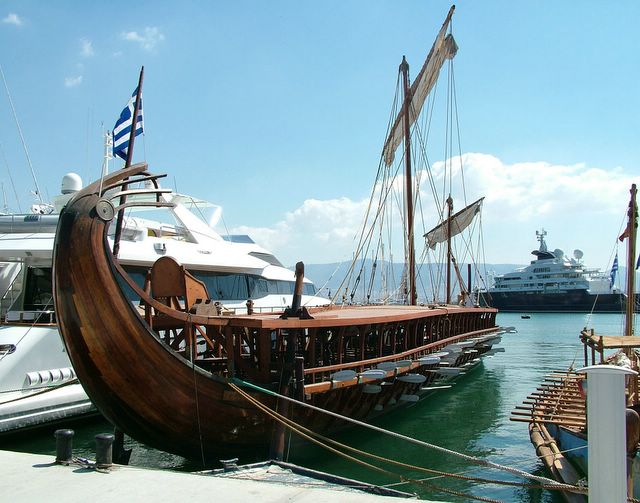
    Ancient Greek ship ("trieres"). Photo by Mr. Panayiotis Giakis, Principal of the 8th Unified Lyceum of Ioannina
    Posted by Hello

    Monday, April 04, 2005

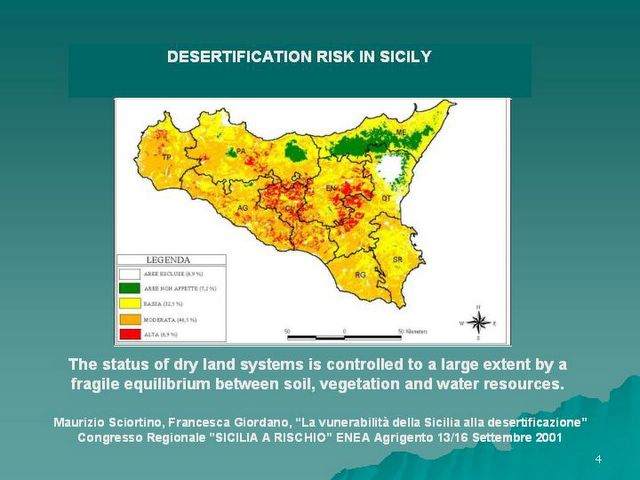
    Presentation of Dr. Claudio De Pasquale's lecture


    Saturday, April 02, 2005


    Posted by Hello

    NATURAL WASTE WATER TREATMENT
    AND ITS IMPACT ON ENVIRONMENTAL LIFE


    Giuseppe Alonzo, Claudio De Pasquale

    ITAF Dept. – Faculty of Agronomy – University of Palermo, Viale delle Scienze,
    90128 Palermo, Italy
    alonzo@unipa.it, claudiodep@hotmail.com


    The total volume of water on the Earth is vast, 1.4 billion km3 (1).However, the proportion of this that is fresh and reasonably accessible is less than 1%, at 11 million km3. There is, therefore, no shortage of water on this planet, just a lack of accessibility to fresh water at some places at some times. Agriculture is the largest user of freshwater, accounting for around three quarters of the entire global consumption (2). However, agriculture does not `consume' water in the conventional sense, since (globally) insignificant amounts of water are actually bound up in the commodities produced. The large amount of water used by agriculture are released through evaporation, which is eventually recycled as rainfall. Agricultural use of water is, therefore, usually much more environmentally clean than domestic or industrial uses, where degradation of the water quality makes its reuse difficult without expensive treatment. It should be noted that the preceding estimates of global water resources and their consumption by agriculture are at best educated guesses (3) and will remain so until more consistent schemes are adopted for the collection, quality control and interpretation of hydrological data.
    Even with the uncertainties in global water use, agriculture remains by far the largest user of freshwater. It has been estimated that global demand for food, fuel and fibre provided by agricultural crops will increase by a factor of between two and six during the next two generations (4). Currently, one sixth of the human population goes hungry on a regular basis and 1 billion people do not have access to clean water (5). Two hundred and thirty million people are living in some 26 countries considered to be water scarce. Countries are normally considered to be water scarce when annual internal renewable water resources are less than 1000 m3 per capita per year. By 2020, the number of water scarce countries is likely to approach 35. Where scarcities loom, competition between industrial, domestic and agricultural water users intensifies and, typically when supplies tighten, agricultural users lose out.
    Moreover, the longer term threat of climate change, as a result of the build up of greenhouse gases, casts ominous shadows over future water budgets (6).
    The global statistics on water resources and forecasts of future needs have prompted many predictions of a crisis in the availability of water resources. It is argued in this paper, however, that this crisis can be averted by managing water resources more efficiently and that this is best achieved within a framework of integrated catchment management (ICM). It is also argued that adopting programmes of ICM can be a key step towards sustainable agricultural development, particularly in semi-arid areas.
    Unfortunately, there is little consensus on the definitions of ICM and sustainable agricultural development (SAD). ICM can be defined as the co-ordinated planning and management of land, water and other environmental resources for their equitable, efficient and sustainable use at the catchment scale. There have been many attempts to define sustainability in absolute terms and, since the Brundtland Commission's definition of sustainability in 1987, at least 70 more definitions have been constructed, each different in subtle ways, each emphasising different values, priorities and goals (7). This said, a definition of SAD that has gained a reasonable level of acceptance is the one proposed by the FAO (1990), whereby SAD is defined as the management and conservation of the natural resource base and orientation of technological and institutional change in such a manner as to ensure the attainment and continued satisfaction of human needs for present and future generations. Such sustainable development conserves land, water, plant and animal genetic resources, is environmentally sound, technically appropriate, economically viable and socially acceptable.''
    To many institutions and agencies, ICM is solely an improvement in catchment planning, whereby relevant central institutions work constructively and in collaboration.
    However, for sustainable agricultural development in a given catchment to be achieved, other stakeholders must participate in the decision-making and implementation processes.
    Major features of ICM programmes, that are beginning to show positive results, include: an overall natural resource management strategy that clearly defines the management objectives, a range of delivery mechanisms that enable these objectives to be achieved and a monitoring schedule that evaluates programme performance; decision-making and action take place at the basin-wide, regional and local levels.
    Wherever possible, local communities are involved both in decision making and in resulting activities; mechanisms and policies are established that enable long-term support to programmes of environmental recovery.
    To protect our groundwater and rivers from impurities, waste water has to be cleaned properly. Our modern sewage treatment plants are expensive, inefficient, and not very effective.
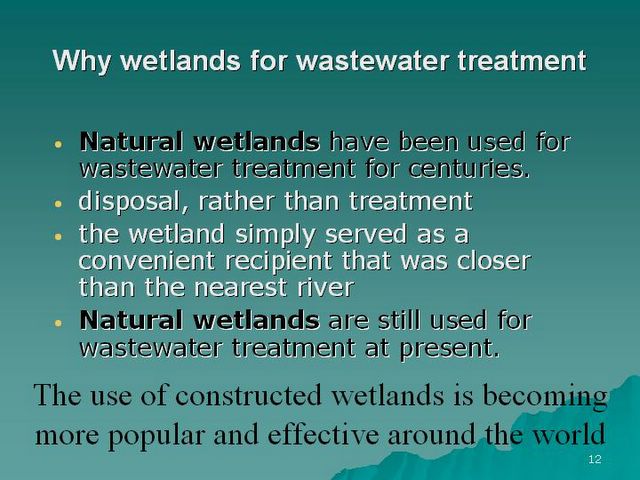
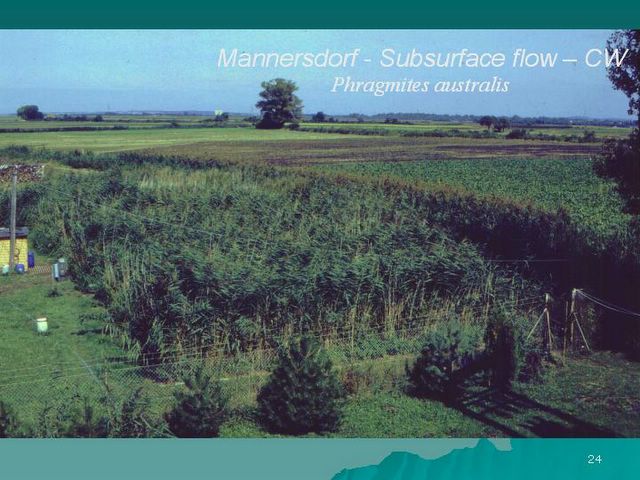
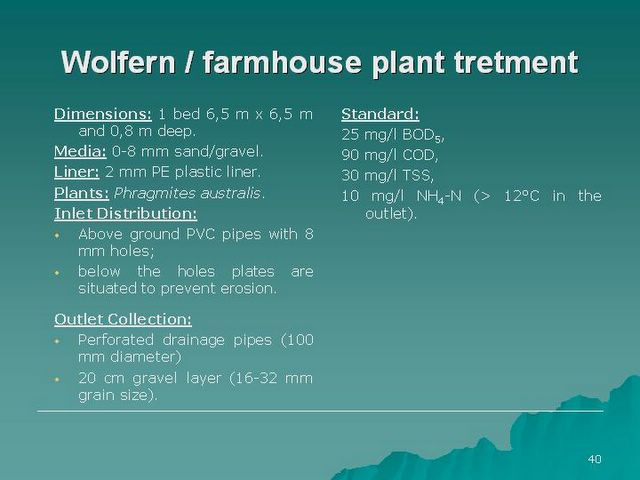
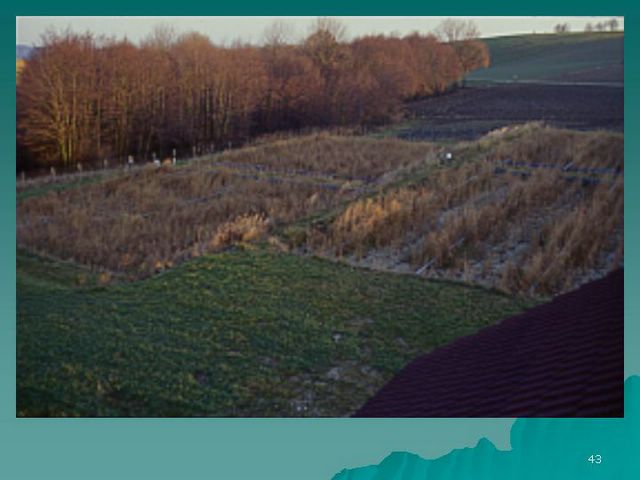
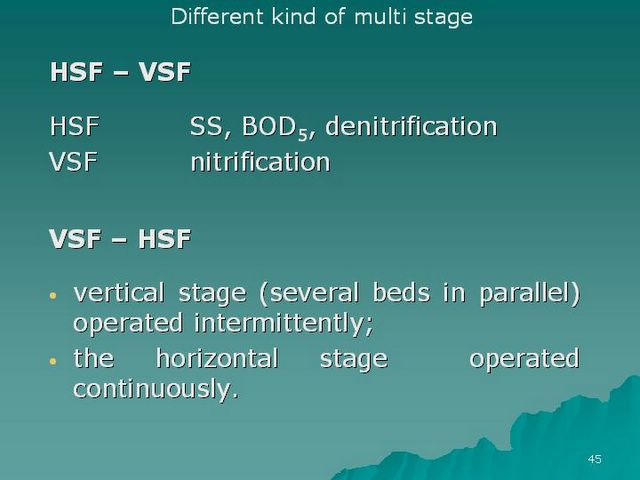
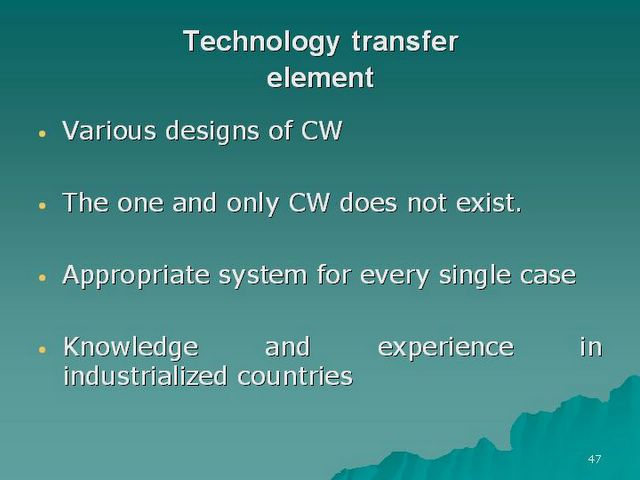
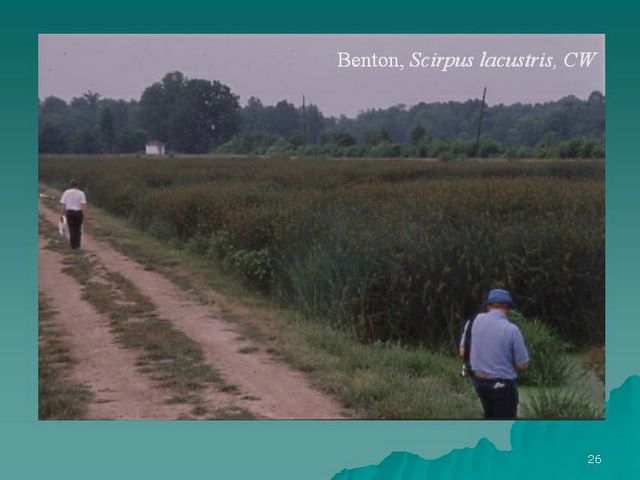
    Natural waste water treatment features small decentralized sewage treatment facilities which use the natural purifying characteristics of marsh plants. These facilities are operating successfully in Germany, Switzerland, and the Netherlands and could be more efficient in Mediterranean area.
    The use of wetlands for treatment can significantly lower the cost of wastewater treatment because the systems rely on plant and animal growth instead of the addition of power or chemicals. Also, the plant communities present in the wetlands naturally adjust to changing water levels and water quality conditions by shifting dominance to those species best adapted to growing under the new conditions.
    Wetlands mean different things to different people. All wetlands are highly productive systems and support high biodiversity. Like other ecosystems, wetlands perform many ecological functions. The hydrological, biological and biogeochemical functions impart them various values. However, it is important to recognize that not all wetlands are similar in their function.
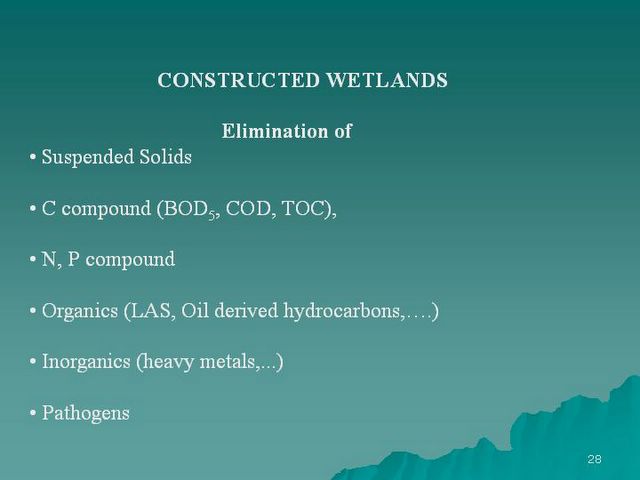
    Nutrient transformation is one of the major wetland functions which is translated into their value for improving the quality of wastewater. Wetlands are now constructed worldwide, designed especially for secondary and tertiary treatment (8). They offers many advantages over the traditional oxidation pods.
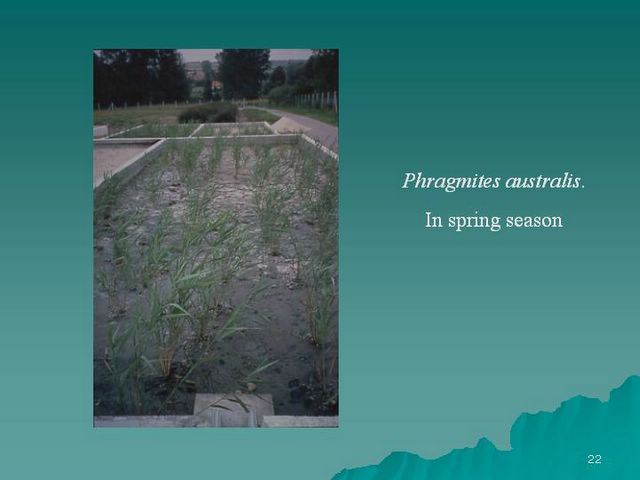
    Aquatic plant are an essential component of constructed wetlands, and contribute to the nutrient transformation by abetting in the physical, chemical, and microbial process besides removing nutrients for their own growth (9). They offer mechanical resistance to the flow, increase the retention time and facilitate settling of suspended particulates. They improve conductance of the water through the soil as the roots grow and create spaces after their death. The plant add organic matter into the water as well as providing a large surface area for microbial growth. Many aquatic plants actively transport oxygen to the anaerobic layers of the soil and thus help in oxidation and precipitation of heavy metals in the root.
    One of the main considerations in promoting the use of constructed wetlands is their relatively low cost for construction, operation and maintenance, relative to the conventional treatment systems.
    Estimates of the land requirement for treating per capita domestic waste based on the nutrient loading rates vary from 10 to 20 person per hectare. The land prices is one of the major deterrent. It is often argued that the wetland systems are more suitable for the tropical/subtropical regions, because of high temperature permitting growth throughout the year. The source and quality of the wastewater are also important factors which should be seriously considered when recommending constructed wetlands in developing country.


    References

    1. Maidment, D.R., 1992. Handbook of Hydrology, McGraw, New York.

    2. Shiklamanov, I.A., 1991. The world's water resources. In: Proc. Int. Symp. to commemorate 25 years of IHP.
    UNESCO/IHP, pp. 93±126.

    3. Rodda, J.C., 1995. Guessing or assessing the world's water resources. J. IWEM 9, 360-368.

    4. Penning de Vries, F.W.T., Rabbinge, R., 1997. Potential and attainable food production in different regions.
    Phil. Trans. Roy. Soc. London, B.

    5. Serageldin, I., 1995. A global vision and required action. Proc. of 2020 Vision for Food, Agriculture and the
    Environment Conf, IFPRI, Washington DC, pp. 129-133.

    6. Postel, S.L., 1993. Water and agriculture. In: Gleick, P.H. (Ed.), Water in Crisis: A Guide To The World's Fresh
    Water Resources, Oxford University Press, Oxford, pp. 56-66.

    7. Pretty, J.N., 1995. Regenerating agriculture: policies and practice for sustainability and self-reliance, Earthscan,
    London.

    8. Kadlec, R . and Brix, H. ,1995. Wetland Systems for water pollution control. Wat. Sci. Tech., 32

    9. Brix, H. 1997.Do macrophytes play role in constructed treatment wetlands. Wat. Sci. Tech., 35
    This lecture was delivered by the writers during the project meeting in Carini-Sicily- Italy (October 2003)

    Friday, April 01, 2005


    The famous Bran Castle near Rucar-Romania. The legend says that there had lived the famous Vlad Ţepeş/the Impaler, Count Dracula. But actually Vlad Ţepeş is a national hero of Romania and defended the independence of his country against the Turkish attacks in the 15th century. In Rucar we 'll have the next project meeting in April 2005. Photo and more information about this castle from the site:http://en.wikipedia.org/wiki/Bran_Castle Posted by Hello